How Can We Integrate Intuitive and Practical Hydrogen Fuel Cells into Education?-ko.hfsinopower.com
다른

블로그

블로그

How Can We Integrate Intuitive and Practical Hydrogen Fuel Cells into Education?

How Can We Integrate Intuitive and Practical Hydrogen Fuel Cells into Education?

Feb 05, 2026

Hydrogen fuel cells, with their high efficiency and cleanliness, have garnered widespread attention in fields such as drones and commercial vehicles. Hydrogen energy education in vocational schools transcends disciplinary boundaries, requiring both theoretical integration and practical support. Therefore, how can we design a truly interdisciplinary and hands-on teaching tool to help students master hydrogen energy technology from principles to applications?


1. Core System Design and Function Implementation


1.1 Hydrogen Supply Unit: Reconstructing Safety Benchmarks with Solid-State Hydrogen Storage


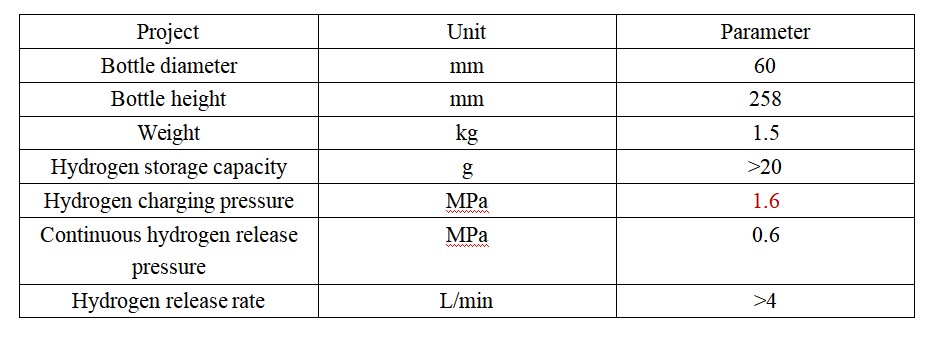
As a core component of hydrogen supply, the key parameters of solid-state hydrogen storage cylinders are as follows:

Safety Core: Our company designed the solid hydrogen storage system with a charging pressure of 1.6MPa , which is far lower than that of high-pressure gas cylinders (usually 35MPa). This physically greatly reduces the risk of leakage and deflagration, making it fundamentally suitable for the teaching environment.

Precise control: By using a combination of pressure reducing valve and solenoid valve in conjunction with a pressure sensor, an intelligent gas circuit management system is constructed to achieve precise regulation of hydrogen flow and automatic overpressure cut-off, integrating industrial-grade safety control concepts into the teaching process.

Fine filtration for protection: A T-type particulate filter is installed in the gas supply line to intercept particulate impurities in hydrogen, protect the fuel cell membrane electrode, extend its service life, and reduce teaching and maintenance costs.


1.2 Power Management and Load Unit Design


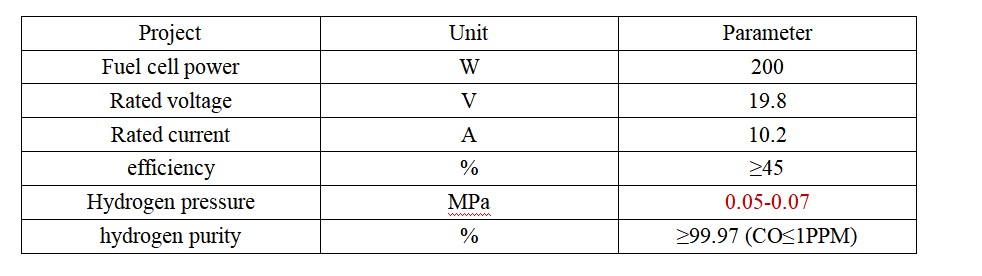
The core parameters of the fuel cell used in this teaching device are as follows:

Fuel cell control unit (FCU): Automatic start-up and shutdown of the fuel cell stack, hydrogen pressure monitoring, overcurrent protection, voltage monitoring, temperature detection, power monitoring , etc.

Lithium-ion batteries provide startup power for the fuel cell control unit (FCU) and drive the hydrogen inlet valve to pre-fill the fuel cell stack with hydrogen until the fuel cell completes electrochemical initialization and reaches a stable output threshold. When the downstream load power is lower than the fuel cell's rated output, the system provides constant current charging to the lithium-ion batteries. If the load power suddenly increases, the lithium-ion batteries respond with high-rate discharge to provide dynamic power compensation.

Voltage regulator module: The power input control unit (FCU) generated by the fuel cell outputs a constant voltage through a DC-DC module to adapt to the external load.

Load and Measurement: Using a fan as a load to simulate real-world power consumption scenarios, this activity visually demonstrates the dynamics of power output. By monitoring the fan's current and voltage in real time using ammeters and voltmeters, students can directly calculate system efficiency, completing a scientific training process from observation to quantification.


1.3 Intelligent Control and Monitoring Unit


System control: Siemens PLC is used to implement reliable logic control at the underlying level (start/stop, interlock protection), and MCGS touch screen is used to provide a user-friendly human-machine interface.

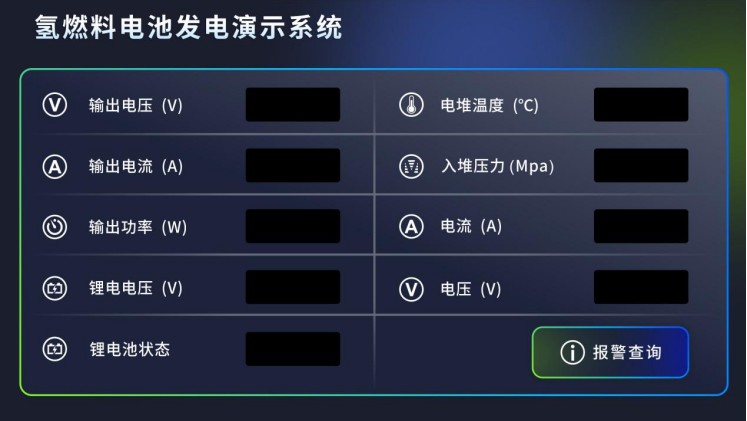
Data visualization and acquisition : The touch screen displays all parameters such as voltage, current, power, hydrogen pressure, and temperature in real time, and supports data export, providing data support for efficiency analysis and characteristic curve plotting.


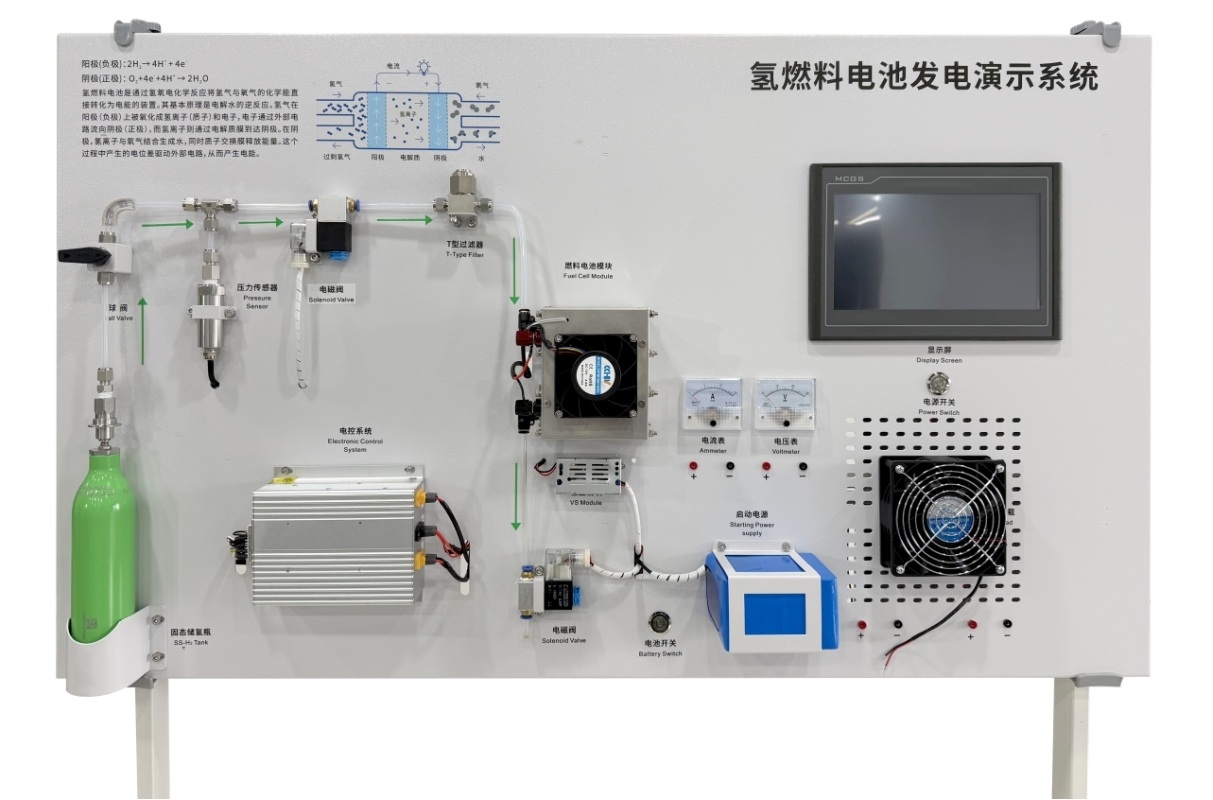
Panel integration design: All components are integrated into the corrosion-resistant panel, with process arrows and text descriptions clearly showing the entire fuel cell power generation chain.


The above is a fully integrated teaching demonstration device for the entire hydrogen fuel cell power generation process. This device integrates modules for solid-state hydrogen storage, fuel cell power generation, power management, and load application, comprehensively demonstrating the core technologies for converting hydrogen energy into electrical energy. Based on proton exchange membrane fuel cell (PEMFC) technology, combined with low-pressure solid-state hydrogen storage and an intelligent monitoring system, the system combines safety, reliability , and teaching applicability. It can be widely applied to experimental teaching and research in disciplines such as new energy, chemical engineering, and electrical automation, contributing to the cultivation of interdisciplinary talents.


2. Pedagogical Value


2.1 Teaching-friendly


Full-process visualization: The device panel clearly marks the entire chain of hydrogen supply, power generation, and power consumption. Combined with the transparent structural design, it can intuitively show the entire electrochemical reaction process, breaking down the abstract barriers of theoretical teaching and helping students quickly understand the core concepts.

Data Quantitative Analysis: Parameters such as power generation efficiency and hydrogen utilization rate are recorded through the MCGS screen to suit the research project.


2.2 Supporting multi-level, inquiry-based experimental teaching:


Basic cognitive experiment: Guide students to observe the entire process of hydrogen power generation and measure the output voltage, current and power under steady state.

Characteristic Investigation Experiments: By changing the load or hydrogen flow rate, the VI characteristic curve and efficiency variation curve of the fuel cell are studied ; the impact of hydrogen purity on power generation efficiency is also investigated.

System integration experiment: Study the compensation behavior of lithium batteries during system startup and sudden load changes, and understand the management strategy of hybrid energy system.

Safety and Control Experiment: Simulate faults such as overpressure and observe the response of the system's automatic protection logic.


3. Design Summary


This hydrogen fuel cell power generation demonstration device is not only an experimental instrument but also a standard component of new energy education. It allows students to move beyond theoretical derivations and engage in hands-on operation, observation, recording, and analysis. Through this device, students can gain a deep understanding of how hydrogen energy is stored, how it is converted into electrical energy, and the losses and efficiency issues during the conversion process. This complete closed-loop demonstration from "hydrogen storage" to "power generation" to "electricity consumption" will undoubtedly inspire more young people to dedicate themselves to new energy scientific research and cultivate high-quality talents adapted to the future energy revolution.

RFQ:

1、Who are we?

We are based in Anhui, China, start from 2011,sell to Southeast Asia,North America,Eastern Europe,South Asia.

2、Does your company offer the aforementioned teaching aids?

Yes.If you are interested, please feel free to contact us at any time.

3、Why should you buy from us not from other suppliers?

We have an experienced professional technical research and development team. Control system matching ability/R&D and quality control ability. Price advantage brought by supply chain integration capabilities.


메시지를 남겨주세요

당사 제품에 관심이 있고 자세한 내용을 알고 싶으시면 여기에 메시지를 남겨주시면 최대한 빨리 답변해 드리겠습니다.
제출하다

우리는 다음으로 수출했습니다.

우리는 다음으로 수출했습니다.

메시지를 남겨주세요

메시지를 남겨주세요
당사 제품에 관심이 있고 자세한 내용을 알고 싶으시면 여기에 메시지를 남겨주시면 최대한 빨리 답변해 드리겠습니다.
제출하다

제품

whatsApp

연락하다